Pomegra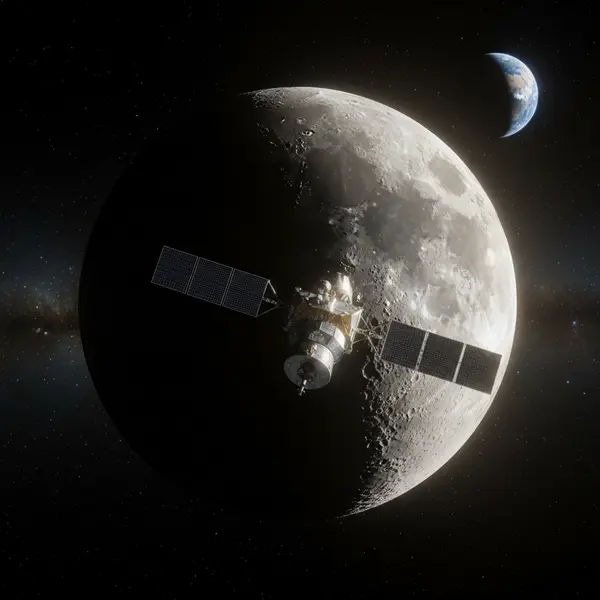
Crew Wakes to Music, Hits Two-Thirds Mark to the Moon
Mission Control roused the four-astronaut crew at 12:35 p.m. EDT to the opening bars of Chappell Roan's "Pink Pony Club," cutting the song just before the first chorus. Commander Reid Wiseman radioed back with characteristic humor: "We were all eagerly awaiting the chorus." At wakeup, the spacecraft had already crossed the two-thirds mark of its journey to the Moon — approximately 169,000 miles from Earth, with the Moon 110,700 miles ahead. The crew is traveling aboard Orion on a free-return trajectory that will loop them around the lunar far side before gravity flings them back toward Earth for a Pacific Ocean splashdown on April 10.
Manual Piloting Demonstration: Hands on the Helm in Deep Space
The highlight of Flight Day 4 was a 41-minute manual piloting demonstration beginning at 9:09 p.m. EDT. Mission Specialists Christina Koch and Jeremy Hansen took turns at the controls of the Orion spacecraft, testing two distinct thruster modes — six degrees of freedom and three degrees of freedom — to provide engineers on the ground with critical data on the spacecraft's deep-space handling qualities. The exercise marks the first time a crew has manually flown a spacecraft at this distance from Earth. Commander Wiseman and Pilot Victor Glover are scheduled to repeat the demonstration on Flight Day 8, April 9, giving mission teams a broader set of piloting performance benchmarks across different crew members.
Lunar Science Targets Assigned for Monday Flyby
With the lunar flyby now less than 48 hours away, the science team downlinked a curated list of surface features for the crew to photograph and document during the six-hour observation window that opens at 2:45 p.m. EDT on Monday, April 6. Orion's main cabin windows will be pointed directly at the Moon throughout the flyby period. At closest approach — 4,066 miles from the lunar surface at approximately 7:02 p.m. EDT — the crew will see the entire Moon at once, including rarely observed polar regions. The vantage point is dramatically different from the Apollo missions, which orbited just 70 miles above the surface.
During the flyby, the astronauts will apply geology training honed on Earth in Moon-analog environments, identifying and photographing impact craters, ancient lava flows, and tectonic surface features such as cracks and ridges. Scientists expect the crew's color, brightness, and texture observations to yield new insights into lunar surface composition and geological history.
A Solar Eclipse from Space and a New Distance Record
Among the most remarkable planned events of the flyby: the crew will witness a solar eclipse from cislunar space. As Orion, the Moon, and the Sun align near the end of the flyby window, the astronauts will see the Sun disappear behind the lunar disk for nearly an hour, revealing the solar corona — the Sun's outermost atmosphere — peeking around the Moon's edge. Scientists are also tasking the crew to watch for meteoroid impact flashes on the lunar surface during this darkened period, gathering hazard data for future surface missions.
The Artemis II mission will also shatter humanity's all-time deep-space distance record. At maximum distance — reached at 7:05 p.m. EDT on April 6 — Orion will sit 252,757 miles from Earth, surpassing the previous record set by the Apollo 13 crew in 1970 by more than 4,100 miles.
Communications Blackout and Far-Side Operations
When Orion passes behind the Moon, mission controllers at NASA's Johnson Space Center in Houston will experience a planned 40-minute communications blackout, beginning at approximately 5:47 p.m. EDT on April 6. The Moon's mass will block all radio signals between the spacecraft and NASA's Deep Space Network (DSN). Similar blackouts occurred during Artemis I and every Apollo mission that flew around the Moon. DSN signal reacquisition is expected promptly upon Orion's reemergence from behind the lunar far side.
Wastewater Vent Issue Resolved; Trajectory Correction Burn Cancelled Again
Flight Day 4 also saw the resolution of a wastewater vent blockage that had developed overnight during Flight Day 3. Controllers suspect that ice buildup had clogged the vent nozzle used to dump liquid waste overboard. Ground teams directed Orion to orient the vent toward the Sun and activated vent heaters, which gradually cleared the blockage. A successful wastewater dump was completed by mid-afternoon Saturday, and the crew resumed normal toilet operations. Flight director Judd Frieling confirmed that each crewmember was issued two contingency collapsible urinal devices as a precaution and was cleared to resume use of the primary system once the vent line was verified clear.
For the second consecutive day, flight controllers also cancelled a planned outbound trajectory correction burn, as Orion's trajectory remains exceptionally precise following the April 2 translunar injection burn — a five-minute, 55-second maneuver that accelerated the spacecraft by 1,274 feet per second. The cancellation carries no implications for mission success.
Optical Communications Milestone: 100 GB Downlinked
Just after noon EDT, the Orion Artemis II Optical Communications System (O2O) surpassed 100 gigabytes of data downlinked during the mission, including high-resolution imagery from Orion's solar array wing cameras. The terminal, mounted externally on the Orion capsule, uses infrared laser communications to transmit data at rates far exceeding traditional radio frequency systems. Engineers view the milestone as a critical validation of laser comms technology for future deep-space and lunar surface operations ahead of the planned Artemis III Moon landing in 2027.
Science Payloads Operating Nominally
Flight Day 4 also saw continued operation of multiple science payloads. The AVATAR payload, carrying bone marrow cells derived from crew blood samples, is operating as expected and will help researchers understand how the human immune system responds to the deep-space radiation environment beyond Earth's protective magnetosphere. The crew collected saliva samples for immune biomarker analysis. German Space Agency (DLR) M-42 radiation sensors, installed throughout Orion's cabin, continued logging radiation environment data in coordination with NASA's own dosimetry instruments. All four crew members continued wearing actigraphy wristbands — compact health monitoring sensors — and completed periodic questionnaires about their onboard experience to support NASA's Standard Measures and ARCHER health data programs.
What Comes Next: Flight Day 5 and the Historic Flyby
The crew entered their sleep period at 3:15 a.m. EDT on April 5, with Mission Control scheduled to wake them at noon Sunday to begin Flight Day 5. A final trajectory correction burn remains on the schedule for Sunday if needed, and the crew will spend the day in final review ahead of Monday's main event. The six-hour lunar flyby broadcast on NASA's YouTube and NASA+ channels beginning at 2:45 p.m. EDT Monday will mark one of the most-watched human spaceflight events since the Apollo era — and the farthest any human crew has ever journeyed from Earth.
--- Artemis II launched April 1, 2026, at 6:35 p.m. EDT from Kennedy Space Center's Launch Complex 39B aboard the Space Launch System rocket. The mission is expected to conclude with a Pacific Ocean splashdown on April 10, 2026.