Pomegra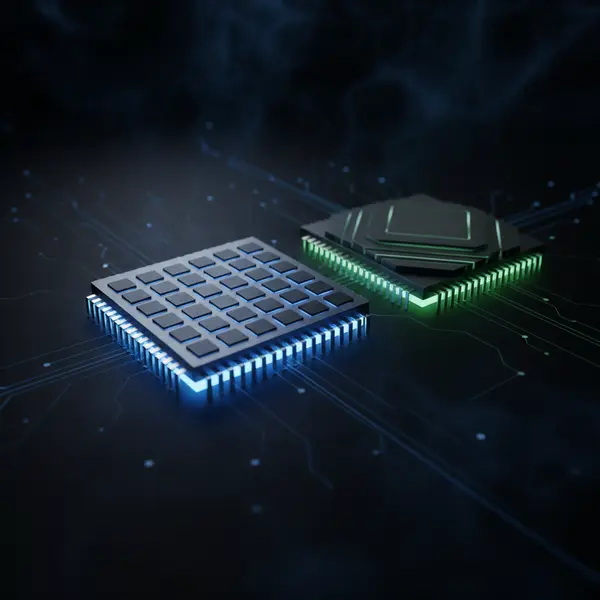
A Deliberate Split in Silicon Strategy
Google Cloud announced on April 22, 2026, that its eighth-generation Tensor Processing Unit (TPU) lineup will for the first time be divided into two purpose-built processors: the TPU 8t, optimized for training large AI models, and the TPU 8i, designed for inference — the process of running AI models in production environments, including powering AI agents. Both chips are slated for general availability later in 2026.
The announcement came during Google Cloud Next 2026 in Las Vegas, one of the most closely watched cloud infrastructure events of the year, with the AI chip landscape commanding center stage.
Performance Gains That Reframe the Cost Equation
The TPU 8t delivers up to 3x faster AI model training compared to its predecessor and is engineered to compress frontier model development cycles from months to weeks. The chip offers 2.8x better price-to-performance than the prior generation — a metric that carries significant weight for cloud customers managing spiraling compute budgets. The TPU 8i, meanwhile, brings 80% better performance per dollar to inference workloads.
Critically, the new architecture supports clusters of more than 1 million TPUs operating in unison, a scale previously unattainable in a single coordinated deployment. The design promises substantially greater compute throughput per unit of energy consumed, directly addressing the growing pressure on hyperscalers to optimize power efficiency alongside raw performance.
Big Tech's AI Lab Deals Fuel the Custom Silicon Boom
The chip launches arrive against a backdrop of accelerating strategic compute partnerships between hyperscalers and leading AI laboratories. Google earlier this month secured an expanded deal with Anthropic to supply "multiple gigawatts of next-generation TPU capacity" to the AI research company. Google is also in discussions to provide OpenAI with TPU capacity, and in February, Meta signed a multiyear, multibillion-dollar agreement for access to Google's TPU infrastructure.
Amazon separately announced an expanded chip deal with Anthropic, under which the AI lab committed to spending more than $100 billion on AWS technologies over the next decade, with Amazon's custom Trainium 3 chips at the center of that arrangement.
The Nvidia Equation: Competition and Coexistence
Despite the aggressive posture of Google's new silicon announcements, the company stops short of a full break from Nvidia. Google confirmed that Nvidia's upcoming Vera Rubin GPU will be made available through its cloud platform later in 2026. Additionally, Google and Nvidia are jointly engineering improvements to Falcon, Google's open-sourced software-based networking protocol, to optimize the performance of Nvidia-based systems running within Google's infrastructure.
Nvidia's data center segment remains the dominant revenue engine for the chip giant, generating $193.7 billion of its $215.9 billion in total fiscal 2026 revenue, with hyperscalers — including Google, Amazon, and Microsoft — collectively representing just above 50% of total data center revenue in Nvidia's most recent quarter. Nvidia has consistently maintained that its reprogrammable GPU architecture serves a broader and more varied range of AI workloads than any single-purpose competitor chip.A Sector-Wide Shift in Custom Silicon Ambitions
The competitive dynamics reflect a structural transformation across the cloud industry. Amazon, Microsoft, and Google are all investing heavily in proprietary AI processors. Meta's MTIA (Meta Inference and Training Accelerator) program targets Nvidia's highest-performance offerings directly, while Microsoft continues development of its own AI silicon roadmap.
Google Cloud's overall market share reached 14% by the end of 2025, still trailing Amazon Web Services and Microsoft Azure, but the accelerated rollout of proprietary TPU generations has become a central tool in the company's effort to narrow that gap by offering enterprises more efficient, cost-effective AI compute alternatives.Market Reaction and Forward Outlook
Shares of Alphabet (GOOGL, GOOG) traded up approximately 1% on Wednesday following the announcements, while Nvidia (NVDA) held near flat, reflecting the market's assessment that the Google launch represents an incremental pressure rather than an immediate displacement threat. AMD (AMD) gained 1.45%, buoyed by continued demand signals across the broader AI chip ecosystem.The dual-chip TPU strategy signals a broader industry consensus forming around workload-specific silicon design — separating training from inference at the hardware level. As AI model deployment shifts further toward always-on inference at scale, the economics of purpose-built chips like the TPU 8i stand to play an increasingly decisive role in how hyperscalers compete for enterprise AI customers and top-tier AI lab partnerships.
---
Mentioned tickers: GOOGL, GOOG, NVDA, AMD, META, AMZN, MSFT