Pomegra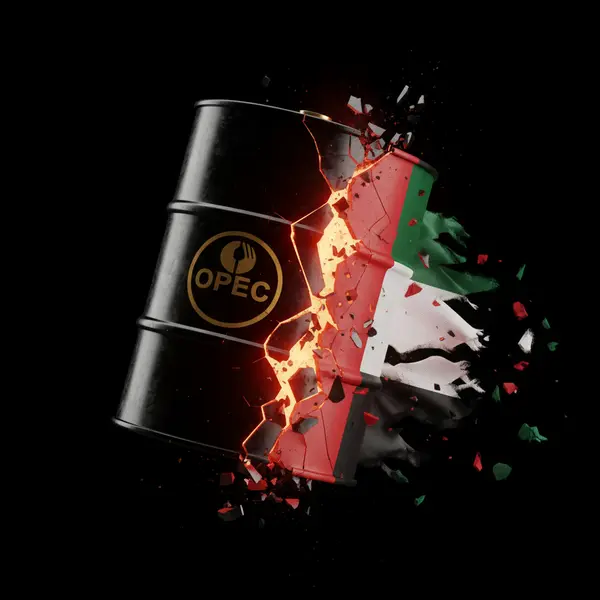
Abu Dhabi Files Formal Notice After Decades of Deepening Rift
The UAE's withdrawal notification marks the culmination of a long-simmering conflict between Abu Dhabi and the Saudi-Russian OPEC+ axis. The central dispute has centered on production quotas that left ADNOC, the Abu Dhabi National Oil Company, sitting on more than 1 million barrels per day of stranded spare capacity — the largest proportional unused capacity burden of any OPEC member. ADNOC raised production capacity to approximately 4 million barrels per day in 2023 with a stated target of 5 million barrels per day by 2027, yet UAE output has been capped well below those levels throughout the period.
The UAE's production capacity versus its allowed quota disparity has cost Abu Dhabi an estimated $50–$70 billion annually in foregone revenues at current prices — a figure equivalent to roughly 20 percent of Abu Dhabi's GDP. With Brent crude now trading near $130 per barrel, those foregone revenues are materially higher than academic projections had previously estimated.
Hormuz Crisis Accelerates Abu Dhabi's Decision
The timing of the formal withdrawal is inseparable from the 2026 Strait of Hormuz crisis triggered by the US-Israeli military campaign against Iran that began February 28, 2026. The closure of the Strait — which handled approximately 18.2 million barrels per day of global oil exports through 2025 — produced the largest oil supply disruption in the history of modern energy markets. Gulf crude and condensate output collapsed by approximately 11.1 million barrels per day month-on-month in March, falling to 16 million barrels per day from 27 million barrels per day in February, a decline larger even than the voluntary COVID-era cuts of May 2020.
The UAE's own production fell 45 percent month-on-month in March to 2.37 million barrels per day against a sustainable capacity of 4.28 million barrels per day, according to the IEA's April 2026 Oil Market Report. ADNOC CEO Sultan Al Jaber declared in early April that "the Strait must be open, fully, unconditionally and without restriction" — a statement that emphasized how profoundly the crisis has disrupted Abu Dhabi's ability to monetize the very production capacity that has driven its frustration with OPEC's quota system.
OPEC's Structural Fracture: Years in the Making
The geopolitical and economic logic driving UAE withdrawal has been building since at least 2016, when Russia's entry into the expanded OPEC+ coalition fundamentally reoriented cartel decision-making toward a Saudi-Russian axis that Abu Dhabi viewed as incompatible with its own strategic interests. The UAE's frustrations reached public visibility in 2021, when Emirati negotiators walked away from OPEC+ output talks, temporarily collapsing cartel decision-making. Abu Dhabi subsequently secured a 10 percent increase in its reference production base to 3.5 million barrels per day — but the concession proved insufficient as ADNOC's capacity expansion continued apace.
The internal dynamics further deteriorated through 2025. The Saudi–Emirati rift, extensively documented before the Hormuz crisis, reflected incompatible economic models: Saudi Arabia requiring elevated oil prices to fund Vision 2030 megaprojects, and the UAE preferring maximum near-term monetization before the global energy transition closes the window on premium fossil fuel revenues. Abu Dhabi's investments through sovereign vehicles including Mubadala, XRG, and ADQ represented a strategic bet on global diversification — one structurally incompatible with OPEC production discipline.
Market Implications: A Historic Realignment
The UAE's departure removes the third-largest producer in OPEC, a country holding sustainable oil production capacity of approximately 4.28 million barrels per day. The move constitutes the most disruptive OPEC exit since the cartel's founding era, far exceeding the market impact of Qatar's 2019 departure, which was driven primarily by Qatar's pivot to natural gas and bilateral political disputes with Saudi Arabia and the UAE.
With the UAE now free of quota constraints, ADNOC is positioned to aggressively pursue its 5 million barrel per day capacity target. The timing, however, creates profound complications. The ongoing Hormuz disruption has forced the UAE to reroute exports through the ADCOP pipeline to the Fujairah terminal on the Gulf of Oman, which carries nameplate capacity of approximately 1.7 million barrels per day — far below Abu Dhabi's full production potential. The UAE's pipeline bypass infrastructure will be central to its ability to rapidly scale output once the Strait normalizes.
Oil market analysts note that in a post-Hormuz normalization scenario, unrestricted UAE production could add between 600,000 and 900,000 barrels per day to global supply above prior quota levels, exerting significant downward pressure on prices at a moment when markets remain deeply uncertain about the pace of Middle East recovery.
Geopolitical Dimension: Washington, Riyadh, and Abu Dhabi's New Calculus
Abu Dhabi's OPEC exit carries substantial geopolitical dimensions. The Abraham Accords, UAE-US security cooperation, and Abu Dhabi's strategic positioning as a pro-Western Gulf partner have long been complicated by its nominal alignment with a cartel whose Saudi-Russian leadership has repeatedly clashed with Washington's preferences on oil production. Leaving OPEC removes that friction, repositioning the UAE more cleanly within the US-aligned security architecture.
The risk of retaliation from Saudi Arabia remains the most significant strategic hazard. Riyadh demonstrated its willingness to deploy price warfare during the early COVID-19 period, and a scenario in which Saudi Arabia floods the market in response to UAE free-riding on OPEC cuts cannot be dismissed. However, the current crisis context significantly reduces Riyadh's ability and incentive to engage in a price war: Saudi Arabia itself is exporting through bypass infrastructure at sharply reduced volumes, and Aramco CEO Amin Nasser has warned of "catastrophic consequences" to the sector from continued energy infrastructure attacks.
OPEC's Existential Question
The UAE withdrawal places OPEC in its most consequential institutional crisis since the 1980s price collapse eroded the cartel's market power. The remaining nine quota-bound members produced just 15.22 million barrels per day in March against a combined sustainable capacity of 27.1 million barrels per day — a system operating at roughly 56 percent of its theoretical ceiling due to the Hormuz disruption. The prospect of a newly unconstrained UAE pumping at full capacity in a post-crisis recovery scenario threatens to overwhelm OPEC's ability to stabilize prices through coordinated discipline.
The global oil balance at the time of the announcement reflects an extraordinary paradox: physical crude benchmarks near $130 per barrel coexist with a UAE producing far below its capacity not because of quotas, but because of war. The immediate market question is not whether OPEC can hold together, but whether there will be a functioning Gulf oil market for any producer — member or otherwise — to operate within before a ceasefire is secured and the Strait of Hormuz reopens.
---
Mentioned tickers: USO, BNO, XLE, CVX, XOM, BP, SHEL, TTE, OXY, COP, SLB