Pomegra
Trump Declares "Massive and Ongoing" Operation Against Tehran
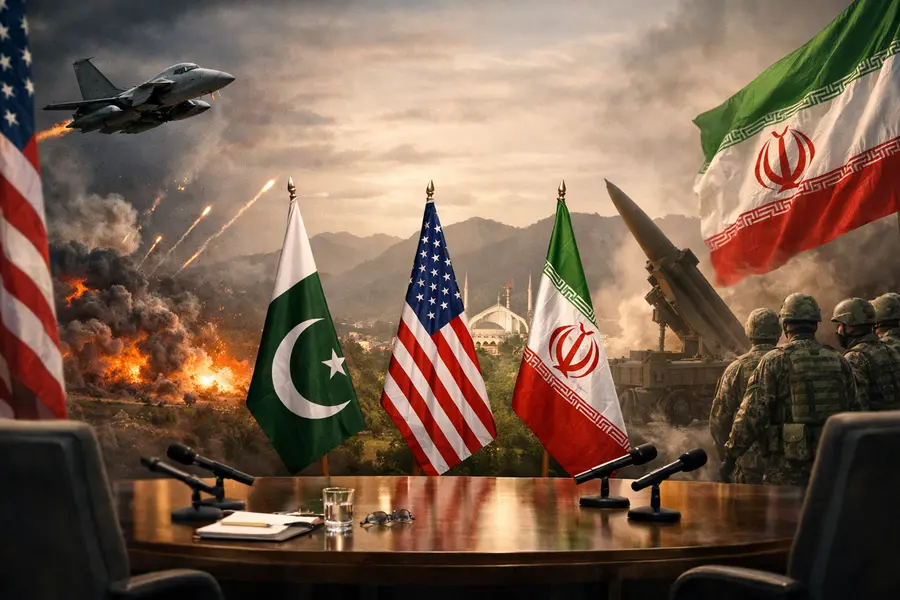
President Donald Trump announced the strike in a pre-recorded video message published on his Truth Social account in the early hours of Saturday morning. "A short time ago, the United States military began major combat operations in Iran," Trump stated. "Our objective is to defend the American people by eliminating imminent threats from the Iranian regime." Trump further vowed to "destroy their missiles and raze their missile industry to the ground," pledging to "annihilate their navy" and sever support to Tehran's regional proxy network. The campaign is expected to extend over multiple days, a U.S. official confirmed.
Israeli Defense Minister Israel Katz described Tel Aviv's role as a "pre-emptive attack" launched to remove existential threats to Israel. An Israeli defense official confirmed the operation, codenamed Roaring Lion, had been planned for months in close coordination with Washington, with the launch date finalized weeks in advance. Explosions were reported in central and eastern Tehran within hours of the strike announcement, with two loud blasts confirmed near the offices of Supreme Leader Ayatollah Ali Khamenei, who was swiftly moved to a secure, undisclosed location.
Iran Retaliates With Missiles and Drones Across the Region
Iran's Islamic Revolutionary Guard Corps (IRGC) confirmed it had launched the first large-scale wave of retaliatory missile and drone strikes toward Israel and toward U.S. military installations in Gulf nations. Bahrain, which hosts U.S. naval assets, issued immediate alerts. Iran's retaliatory strikes targeted at least seven American military bases across Gulf Cooperation Council (GCC) countries, mirroring a precedent set in June 2025, when Tehran fired missiles toward the Al Udeid air base in Qatar — the largest U.S. base in the Middle East — following a prior joint Israeli-American campaign against Iranian nuclear facilities.
Israel closed its civilian airspace, ordered the shutdown of schools and non-essential workplaces, and activated nationwide sirens by 8:15 a.m. local time. Iran simultaneously placed its own air defenses on full alert and warned all neighboring governments hosting U.S. forces of consequences for their complicity.
Diplomatic Collapse Preceded the Strikes
The military operation follows a prolonged breakdown in nuclear diplomacy between Washington and Tehran. The U.S. and Iran had resumed negotiations in February 2026 in Geneva in an attempt to resolve the decades-long nuclear standoff. Talks collapsed without a breakthrough, and Trump had signaled to reporters just days earlier that the window for diplomacy was closing, offering Tehran a 10-to-15-day deadline to reach a deal — a window that expired with Saturday's strikes.
Israel had repeatedly demanded that any U.S. agreement with Iran include the full dismantlement of its nuclear infrastructure, not merely a freeze on uranium enrichment, and insisted that restrictions on Iran's ballistic missile program be included in any framework. Iran flatly rejected linking its missile program to nuclear negotiations. Trump underscored Tehran's failure to comply: "They rejected every opportunity to renounce their nuclear ambitions... Instead they attempted to rebuild their nuclear program and continue developing long-range missiles that can now threaten our allies in Europe and could soon reach the American homeland."
Crude Oil Surges, Gold Hits Record, Equities Face Headwinds
Global financial markets reacted with immediate turbulence. Crude oil futures surged +3.19% to $67.29 per barrel, with Brent also moving sharply higher, as traders priced in the severe risk of supply disruption through the Strait of Hormuz — a strategic waterway through which approximately one-fifth of global oil supply transits daily. Iran's leverage over the Strait represents the most acute commodity risk embedded in the escalation. Gold leapt +1.97% to $5,296.50 per troy ounce, extending a historic February run in which the precious metal posted a +11% monthly gain, its largest one-month percentage advance since January 2012. Gold's $516.60 net monthly gain was the largest single-month nominal move on record, according to Dow Jones Market Data, as haven demand intensified throughout February amid compounding geopolitical and economic pressures. Bitcoin — serving as a real-time early-reaction gauge given its 24/7 trading hours — slid 3.1% to $63,561, a level last seen in early February, signaling risk-off positioning across digital asset markets as investors rotated into conventional safe havens.Equity futures pointed to a deeply negative open for the coming week. The S&P 500 (SPX) entered the weekend already down -0.43% on Friday, the Dow Jones Industrial Average (DJIA) fell -1.05%, and the Nasdaq Composite (COMP) slid -0.92%, all pressured by a surprise spike in producer price inflation before the strike was even confirmed. The VIX fear index spiked +6.60% to 19.86. U.S. 10-year Treasury yields pulled back to 3.952%, as investors fled into government debt. The Swiss franc and Japanese yen both strengthened as classic safe-haven currencies absorbed capital inflows.
Defense Sector Positioned for Sharp Gains
Market consensus rapidly coalesced around a sector rotation into defense and aerospace equities, which stand to benefit directly from an extended, high-intensity military campaign. Michael Brown, senior research strategist at Pepperstone, characterized the expected market reaction as "relatively predictable" — a surge in crude prices, a bid for gold, Treasurys, yen, and Swiss franc, and headwinds for broad equity markets and risk assets. Brown cautioned, however, that "geopolitical events tend not to be a trigger for durable or longer-lasting market moves in any asset," suggesting initial shock volatility may not translate into a sustained directional shift once markets fully price in the scope of the operation.
Strategic Context: A Second Campaign in Eight Months
Saturday's strikes mark the second major U.S.-Israeli military operation against Iran within eight months. The first, conducted in June 2025, targeted three Iranian nuclear installations and was the most direct American military action against the Islamic Republic in history. Trump cited Iran's decision to rebuild its nuclear program after those strikes as the trigger for the current campaign. Saturday's operation is expected to be far more extensive than June's targeted strikes, with current objectives encompassing Iran's nuclear infrastructure, ballistic missile industry, naval assets, and leadership command structure.
Iran's supreme leader, the targets of critical infrastructure, and the reach into Gulf regional military assets all indicate a theatre-wide escalation unlike prior episodes of U.S.-Iran confrontation. The operation is unfolding during Ramadan — a symbolically charged timing in the Muslim world — and immediately ahead of the Jewish holiday of Purim, which begins Monday.
Market Outlook: High Volatility Week Ahead
With Asian markets set to open Sunday and full equity markets resuming Monday, the coming week carries elevated risk of sharp dislocations across crude oil, equity indices, currency markets, and fixed income. The trajectory of Iranian retaliation — particularly any escalation involving the Strait of Hormuz or expanded strikes on Gulf infrastructure — will be the primary determinant of whether the initial market shock deepens or stabilizes. Gold and energy equities enter the week as the consensus overweight positions, while broad equity indices, tech stocks, and risk assets face near-term pressure from a combination of geopolitical shock, persistent inflation, and AI-driven earnings uncertainty that had already been weighing on markets entering the weekend.
---
Mentioned tickers: `SPX`, `DJIA`, `COMP`, `VIX`, `CL.1`, `BRN00`, `GC00`, `BTCUSD`, `TMUBMUSD10Y`, `TMUBMUSD30Y`, `USDJPY`, `USDCHF`