Pomegra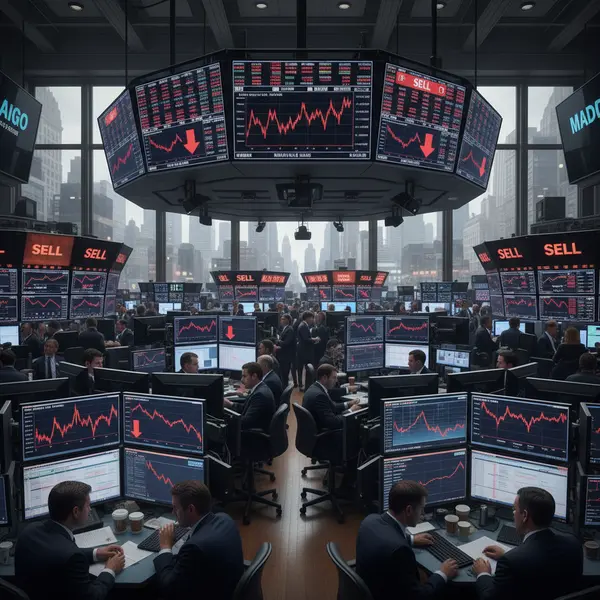
The stock market suffered another punishing session Thursday as artificial intelligence fears continued to grip Wall Street, with the Dow Jones Industrial Average plunging 669 points or 1.34% to close at 49,451.98. The benchmark S&P 500 dropped 1.57% to finish at 6,832.76, while the tech-heavy Nasdaq Composite bore the brunt of selling pressure, tumbling 2.03% to end at 22,597.15.
Technology Sector Leads Broad-Based Decline
Technology stocks spearheaded the market's third straight day of losses as investors grappled with mounting concerns over AI disruption across traditional business models. Software companies faced particularly intense selling pressure, with Palantir Technologies and Autodesk among the notable decliners as disruption worries plagued the sector throughout recent weeks.The selloff intensified after several trucking and logistics firms declined on fears that new AI tools could dramatically reduce freight inefficiencies, potentially diminishing demand for industry services. This sparked broader concerns about which sectors might face similar AI-driven disruption next, creating a cascading effect across multiple market segments.
Cisco Systems Drives Dow Weakness
Cisco Systems emerged as the day's worst Dow performer, plummeting 12% after the networking equipment giant issued disappointing guidance for the current quarter. The company's tepid margin outlook signaled higher costs ahead, contributing to broader technology sector weakness and dragging the blue-chip index below the psychologically important 50,000 level.Real estate and financial stocks also suffered significant losses, with commercial real estate brokers extending their decline for a second consecutive day. The broad-based nature of the selloff reflected growing investor anxiety about AI's potential to disrupt traditional business models across multiple industries.
Asian Markets Follow Wall Street Lower
Asian equity markets tracked the negative sentiment from Wall Street, with Japan's Nikkei 225 falling 1.21% to close at 56,941.97 after briefly touching 58,000 the previous day. South Korea's Kospi reversed earlier gains to finish down 0.28% at 5,507.01, ending a four-day winning streak.Chinese technology stocks also faced pressure, with Alibaba declining 2.14% and Baidu dropping more than 3%. Hong Kong's Hang Seng Index fell 1.71% in its final trading hour, weighed down by basic materials stocks, while mainland China's CSI 300 lost 1.25% to close at 4,660.41.
Market Volatility Indicators Signal Continued Uncertainty
The VIX volatility index climbed to 20.82, reflecting heightened investor anxiety about near-term market direction. Trading volumes remained elevated across major exchanges as institutional investors reassessed portfolio positions amid the ongoing AI disruption narrative.
Despite some pockets of strength in certain AI-focused Chinese companies, with Zhipu AI extending its rally by 16% following Thursday's nearly 30% surge, the overall market sentiment remained decidedly negative. The contrast highlighted the selective nature of AI-related investment flows, with established technology companies facing pressure while pure-play AI developers attracted continued interest.
Economic Data and Federal Reserve Policy in Focus
Looking ahead, investors await key economic data releases that could influence Federal Reserve policy decisions. The market's reaction to AI disruption concerns comes as traders continue to assess the central bank's monetary policy stance amid evolving economic conditions.
The persistent selling pressure across major indexes suggests investors remain cautious about the pace of technological change and its impact on corporate earnings. Market participants are closely monitoring which industries might face similar disruption challenges, creating an environment of heightened uncertainty that has characterized trading sessions throughout the week.
Mentioned tickers: CSCO, PLTR, ADSK, BIDU, 9988.HK, SPY, QQQ, DIA