Pomegra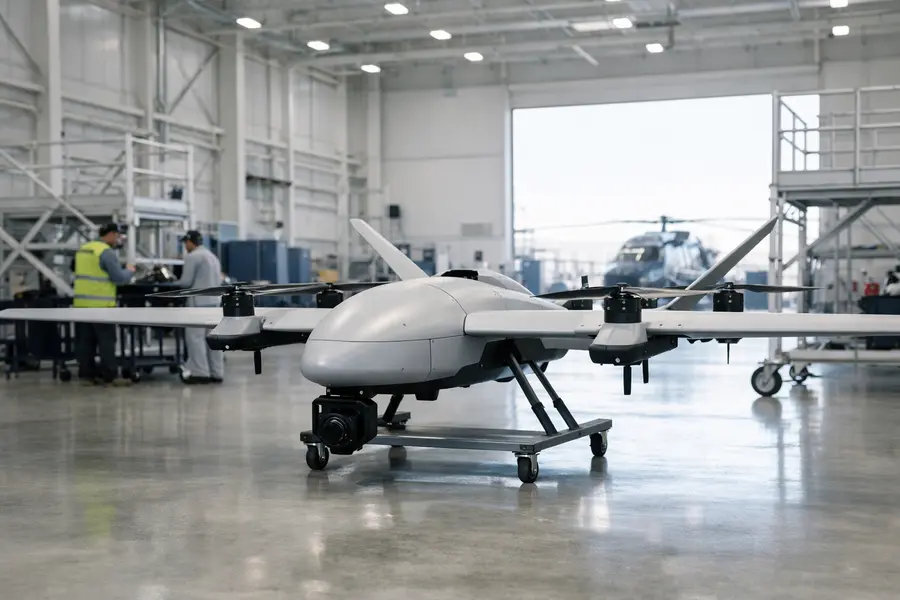
SiFly Aviation's $20M Series A, led by Shield Capital, funds U.S. production of the Q12 electric drone for public safety and infrastructure inspection.
- SiFly Aviation raised $20M in a Series A led by Shield Capital, with Qudit, BBK Capital, and Alumni Ventures participating, announced August 26, 2026.
- The Q12 quadcopter holds a Guinness World Record for electric drone endurance at 3 hours 11 minutes, reaching 90 miles on a single charge with a 10-pound payload.
- SiFly targets first revenue-generating deliveries in Q1 2027 and projects shipments of roughly 1,000 units through the year.
Lead
SiFly Aviation closed a $20 million Series A on August 26, 2026, led by defense-focused venture firm Shield Capital, with Qudit, BBK Capital, and Alumni Ventures rounding out the round. The Santa Clara, California startup will use the capital to ramp domestic manufacturing of its Q12 long-endurance electric quadcopter and advance field testing of DronePort, its multi-drone ground infrastructure platform. Valuation was undisclosed.
What Makes the Q12 Different?
The Q12 is not competing on price - it's competing on time in the air. The 30-pound aircraft can hover for two continuous hours and travel forward for up to three, reaching 90 miles while carrying a 10-pound payload. Leading enterprise quadrotors average roughly 40 minutes of flight; SiFly claims the Q12 flies four to five times longer and extends range by up to ten times.
In July 2025, the Q12 set a Guinness World Record for electric drone endurance at 3 hours 11 minutes. That stamina matters to the customers SiFly is targeting: fire departments running Drone-as-First-Responder programs, utility operators inspecting hundreds of miles of power lines per sortie, and pipeline companies covering remote terrain without mid-mission battery swaps. Each of those use cases is defined by how long the aircraft stays up, not how quickly it deploys.
Who Is Shield Capital, and Why This Bet?
Shield Capital closed its debut fund at $186 million in 2022, 55 percent above its initial target, and focuses on dual-use technology at the intersection of commercial markets and national security. Its portfolio spans cybersecurity, autonomous systems, and space, and the firm now manages more than $300 million in assets across 36 portfolio companies.
The thesis behind the SiFly investment is a production bet, not a technology proof-of-concept. The Q12 has its Guinness record. The question is whether SiFly can build a thousand of them on time, at cost, in the United States - and do so while navigating procurement rules that increasingly favor domestic supply chains. Shield's defense-sector relationships give the company a foothold in that sales environment that pure commercial VCs cannot offer.
Does "NDAA-Compliant" Hold Up?
Here the picture gets complicated. The Q12 received conditional National Defense Authorization Act approval in March 2026, valid only through December 31, 2026. The NDAA-compliant designation applies to the drone's cameras and radios - not its motors, which are sourced from Chinese suppliers.
That distinction matters for the government contracts and public-safety agencies SiFly is targeting. Procurement rules designed to reduce dependence on Chinese-made components draw no bright line between a compliant sensor stack and a non-compliant drivetrain; individual agencies make their own calls. SiFly's conditional approval opens a window for federal and municipal sales, but that window closes before the bulk of its projected 2027 production run ships. Whether the company secures renewal - or transitions to non-Chinese motor suppliers - will determine how much of that 1,000-unit target is actually accessible to government buyers.
DronePort: The Infrastructure Play
Alongside the Q12, SiFly is developing DronePort, a ground infrastructure system that fits three to four Q12s into roughly the footprint of a single parking space, equivalent to a 20-foot shipping container. The company says DronePort delivers five times the operational coverage of traditional single-dock systems at up to ten times lower deployment cost per node.
The economics, if they hold, address a persistent complaint about enterprise drone programs: ground infrastructure costs often rival or exceed the aircraft itself. A denser, lower-cost launch-and-recharge network changes the math for agencies trying to build regional coverage without regional budgets.
Outlook
SiFly enters Q4 2026 with fresh capital, a 1,000-unit production target for 2027, and a drone that has demonstrated real technical performance under controlled conditions. The immediate pressure is structural: the NDAA conditional approval expires December 31, and first deliveries begin in Q1 2027. That sequencing is tight. Autonomous systems investment has accelerated across the defense-tech sector as U.S. policy pushes domestic sourcing, and SiFly is positioned to benefit from that tailwind - provided it resolves a compliance clock that is already running.