Pomegra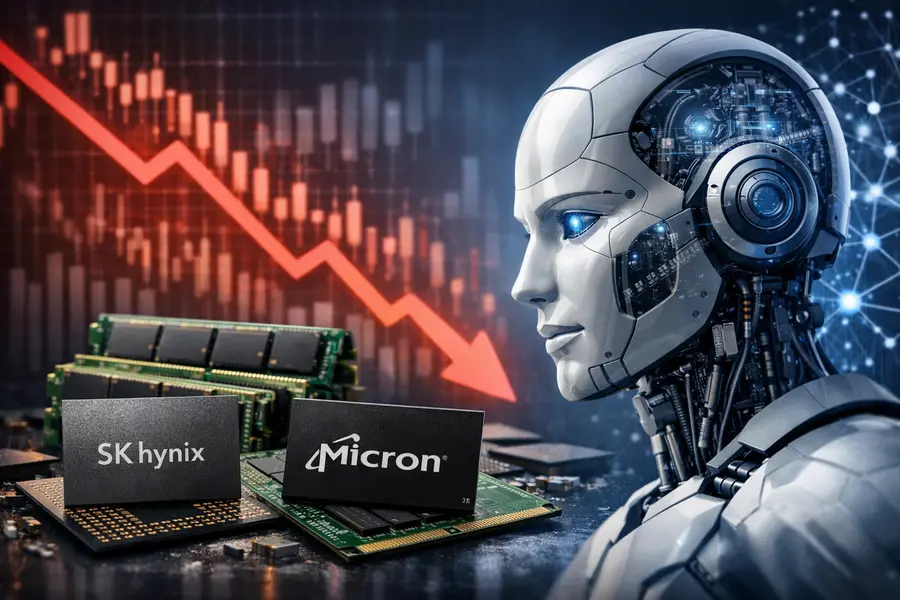
What Happened
A sharp technology selloff that began on Wall Street in late June 2026 spread to Asian markets on July 2, forcing a rare trading halt on South Korea's Kospi index. SK Hynix shares fell approximately 14.6% in a single session, and Samsung Electronics dropped roughly 9%. In the preceding U.S. session, Micron Technology had already declined more than 10%, while peers including SanDisk and Western Digital fell around 7%.
- SK Hynix fell 14.6% and Micron shed 10%+ in early July 2026 amid reports of slowing HBM expansion and AI spending doubts.
- Both companies have committed entire 2026 HBM output under pre-negotiated price and volume contracts, locking in revenue against a potential AI chip oversupply risk.
- Micron raised fiscal 2026 capex guidance to $25B+; SK Hynix is spending $30B+ on new capacity, with HBM4 volume production targeted for late 2026.
The proximate trigger was a report indicating SK Hynix planned to slow its high-bandwidth memory (HBM) production expansion — a signal investors read as a rare acknowledgment of risk in what had until then been a near-unbroken 18-month uptrend for memory chip stocks. Meta Platforms' disclosure that it was building a cloud business to monetise surplus AI computing power added to concerns that hyperscaler AI chip orders could plateau sooner than expected.
The drawdown came after extraordinary gains. Micron stock had risen approximately 245% year-to-date heading into the selloff, and both SK Hynix and Micron had crossed $1 trillion market capitalizations in the preceding months.
Strategic Buffers in Place
Despite the market turbulence, the two companies' near-term revenue positions are heavily ring-fenced. SK Hynix's entire 2026 HBM allocation has been sold under multi-year customer agreements, with HBM4 pricing reportedly carrying a roughly 50% premium over HBM3E. Micron disclosed in its fiscal Q3 2026 earnings that its full calendar-year 2026 HBM output is committed under binding price and volume contracts, with supply tightness expected to extend beyond 2026.
Those contractual structures function as the primary buffer against a sudden memory chip slump. Even if hyperscalers reduce forward orders or revisit capex priorities, the immediate revenue base for both companies is structurally protected through at least the end of this year.
The two chipmakers have also diversified risk across product generations. SK Hynix is co-developing HBM4 with TSMC for volume shipment in late 2026 or early 2027, maintaining a product pipeline that extends regardless of near-term AI cycle volatility. Micron's portfolio spans DRAM, NAND, and HBM, giving it consumer and enterprise exposure that can absorb fluctuations in any single end market.
Earnings Landscape
Micron's fiscal Q3 2026 results — released before the selloff accelerated — reported revenue of $41.46 billion, a 346% increase year-over-year, with non-GAAP gross margin guided at approximately 81% for the quarter. The company raised its full fiscal 2026 capital expenditure target to more than $25 billion, a 25% increase from prior guidance, signalling confidence in sustained AI infrastructure buildout even as markets repriced.
SK Hynix posted record first-quarter 2026 profit in line with estimates, driven by HBM3E shipments to Nvidia and other AI accelerator customers. Full-year 2026 consensus projects net income of 221 trillion won (approximately $144 billion), up 415% from 2025.
The Oversupply Scenario
The semiconductor industry has historically cycled sharply between shortage and glut. DRAM inventories at major suppliers fell to roughly 3.3 weeks by the end of Q3 2025 — matching the 2018 supercycle trough — with SK Hynix and Micron each carrying approximately two weeks of inventory cover.
SK Hynix's recent U.S. Securities and Exchange Commission filings, associated with its planned $29 billion Nasdaq listing, explicitly acknowledged the downside: a slowdown in AI infrastructure investment could lead customers to reduce or delay capital expenditure, forcing the company to cut prices and rationalise production capacity. That language reflects standard cyclical disclosure, but it also maps the specific fault lines that concern investors.
The academic community has begun flagging similar risks. A Harvard chip economist publicly noted in May 2026 that HBM's premium economics are real but cyclical — warning that if AI funding sentiment shifts, memory makers who over-invested on long lead-time fabs could face severe excess capacity by 2028. The AI chip oversupply risk is not the immediate story, but it is the medium-term scenario both companies are designing against.
Capex as a Two-Edged Sword
The same investments that protect long-term competitiveness also amplify downside exposure if demand stalls. SK Hynix has committed to more than $30 billion in new capacity, including a $15 billion advanced packaging facility in the United States — critical for HBM4 assembly — and a $14.6 billion M15X fab in South Korea. Micron's programmes include a $24 billion facility in Singapore, plus fabs in New York and Idaho backed by $6.14 billion in CHIPS Act funding.
Neither company's major new capacity comes online in volume before 2027–2028, providing a natural runway before new supply could pressure pricing. That timing gap is deliberate: by pre-selling current production under contract and gating new supply to anticipated future demand, both SK Hynix and Micron are structuring their capacity additions to avoid the inventory gluts that triggered the 2022–2023 memory downcycle.
Geopolitical and Competitive Dimension
U.S. export controls on advanced chips to China remain a structural tailwind for HBM pricing, restricting the ability of Chinese memory producers to compete at the HBM4 technology node. The ongoing build-out of AI data centres in the U.S. and Europe, driven partly by reshoring incentives, supports sustained HBM demand. Samsung's continued struggles with HBM qualification for Nvidia's latest platforms have, for now, narrowed competitive pressure on SK Hynix in the highest-margin segment of the market.
Outlook
The July selloff exposed the gap between semiconductor industry fundamentals and elevated valuations, but it did not alter the near-term supply-demand equation. HBM inventories remain critically low, 2026 output is contractually committed, and HBM4 ramps begin in the second half of the year. The structural risk — AI chip oversupply risk materialising if hyperscaler AI spending decelerates sharply after 2026 — is real but not yet visible in order books. SK Hynix and Micron have built meaningful contractual, generational, and geographic buffers, though both companies' long-term economics remain tightly coupled to the assumption that AI infrastructure investment continues at or near current scale.